



HIV Testing Overview
Summary
- HIV testing is available in health care or lab settings, community-based organizations, and even at home.
- Get tested today by buying an HIV self-test at a pharmacy, ordering one online, or requesting a free kit through CDC’s Together Take Me HomeExit Disclaimer program (subject to availability).
- HIV tests can’t detect HIV immediately after exposure—HIV may not show up on some tests until 90 days after you have been exposed.
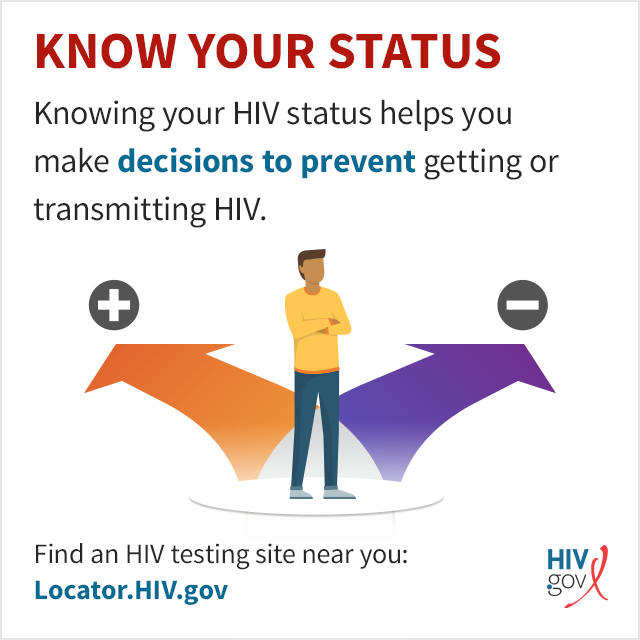
- Use the HIV Services Locator to find convenient testing sites or at-home testing options that work for you.
What Can You Expect When You Get an HIV Test?
There are many ways to get tested for HIV. Your HIV testing experience might differ depending on where you get tested and the types of tests offered at a particular location.
HIV Testing in a Health Care Setting or Lab
If you take a test in a health care setting or a lab, a health care provider or lab technician will take a sample of your blood or oral fluid. If it’s a rapid test done by taking oral fluid or by pricking your finger for a few drops of blood, you may be able to wait for the results. If it’s a blood sample that goes to a lab, it can take several days for your results to be available.
Your health care provider or counselor may talk with you about your HIV risk factors, answer any questions, and discuss the next steps with you, especially if your rapid test result is positive.
HIV Testing in a Community-Based Setting
If you get an HIV test outside of a health care setting or lab—such as at a community-based organization, mobile testing van, or elsewhere—you will likely receive a rapid HIV test.
Learn about the different places where you can get an HIV test and how much it may cost.
Will an HIV Test Detect HIV Immediately After Exposure?
No, HIV tests cannot detect HIV immediately after exposure, including blood tests sent to a lab. This is because of the window period—the time between when a person gets HIV and when an HIV test can accurately detect it. The window period varies from person to person and depends on the type of test. The window period can be anywhere from 10 days to 90 days.
If you think you’ve been exposed to HIV in the last 72 hours, the first step is to talk to your health care provider as soon as possible about post-exposure prophylaxis (PEP).
What Do HIV Test Results Mean?
If your test comes back negative:
- If you have not had a possible HIV exposure during the window period for the test you took, you can be confident you don’t have HIV.
- If you have had a possible exposure during the window period, you’ll need to get tested again after the window period, even if your test was negative. In the meantime, you can take steps to protect your health, like using PrEP.
If your test comes back positive:
- The next step is to get follow-up testing to confirm the result.
- You can get follow-up testing through the original testing location, your regular provider, or an HIV care provider.
- Talk to someone at your testing location to get more information on what to do next.
What if You Can’t Pay for an HIV Test?
As required by the Affordable Care Act, HIV screening is covered by health insurance, including most Medicaid programs, without a co-pay. If you don’t have health insurance, some testing sites, health centers, or local health departments may offer free tests. Use CDC’s Get Tested to search for free or low-cost testing near you.
Can You Self-Test for HIV at Home?
Yes. An HIV self-test is done entirely at home or in a private location, and you can get your test results within 20 minutes.
You can buy an HIV self-test at a pharmacy or online, or you can order a free HIV self-test through CDC’s Together Take Me HomeExit Disclaimer initiative (subject to availability). There are only two rapid self-tests currently approved by the FDA. One is an oral fluid test, and the other uses a drop of blood from a fingerstick. You should always interpret the self-test results according to the manufacturer’s instructions. A phone number is included if you need help. If you get a positive result from an HIV self-test, you will need to get a second test from a health care provider to be sure of your status.
Check to see if your local health department or an HIV service organization near you provides free or low-cost HIV self-tests. HIV self-tests may also be covered by insurance. Check with your insurance provider or health care provider about reimbursement for tests you purchase.
Note: State laws regarding self-testing vary and may limit availability. Check with your provider about testing options.
Types of HIV Tests and Their Window Periods
There are three types of HIV tests and they all have different window periods.
Nucleic acid test (NAT):
- A NAT looks for the actual virus in your blood and can usually detect HIV infection 10 to 33 days after exposure.
- It is performed by a lab using blood from your vein (not a finger prick).
Antigen/antibody test:
- This test looks for both HIV antigens and antibodies in your blood.
- An antigen/antibody test performed by a laboratory using blood from your vein can usually detect HIV infection 18 to 45 days after exposure.
- An antigen/antibody test done with blood from a finger prick can take longer to detect HIV infection, anywhere from 18 to 90 days after exposure.
Antibody test:
- An antibody test looks for antibodies to HIV in your blood or oral fluid and can usually detect HIV infection 23 to 90 days after exposure.
- Most rapid tests and self-tests are antibody tests.
- In general, antibody tests that use blood from a vein detect HIV infection sooner after exposure than tests done with blood from a finger prick or with oral fluid.
Ask your health care provider or HIV testing counselor about the window period for your test and whether you will need a follow-up test to confirm the results. If you’re using a self-test, you can get that information from the materials included in the test’s package.
If you get an HIV test after a potential HIV exposure and the result is negative, the next step is to get tested again after the window period. You can only be sure you are HIV negative if:
- Your most recent test is after the window period.
- You haven’t had a potential HIV exposure during the window period. If you have had a new potential exposure, then you will need to be retested.
